Since the AI gold rush hit, I've noticed something:
A lot of us aren't really "using AI" anymore.
We're running a digital harem.
First thing every morning,
not checking stocks,
not checking the news.
Checking whether our agents "evolved" overnight.
One runs the blog.
One posts to Twitter.
One edits videos.
One monitors GitHub.
One auto-summarizes the news.
And one stands guard on WhatsApp,
like a night-shift security guard.
Then the master sips his coffee,
patrolling his cyber domain.
Dashboard open,
like an emperor at morning court.
"Did OpenClaw crash last night?"
"Did Hermes memory leak?"
"Is Claude cowork having a bad day?"
"Is Suno web use stable?"
"How many Fish Audio credits left?"
That sense of control is intoxicating.
A scholar who never leaves his study, yet runs the world.
The best part:
The whole setup keeps feeding you the illusion
that you're changing the world.
Because it never stops moving.
Logs scrolling.
Workflows running.
Automation executing.
Terminals blinking.
GitHub commits piling up.
Agents even report back to each other,
often with wit and humor.
Like a tiny civilization.
And that's how you fall in.
It started as:
"Let AI handle some chores."
It became:
"I will build my own AI empire."
Then the infrastructure frenzy:
Wire up MCP.
Set up memory.
Build routing.
Write skills.
Train personas.
Hook up Telegram. Or WeChat.
Add voice.
Add Suno.
Add WordPress.
Build a custom app.
Wrap it in a dashboard.
Add an auto-publishing pipeline.
Tack on a long-term knowledge base.
It just keeps growing.
Until finally, you've built
your own automation kingdom.
And after 24 hours of stable operation,
it auto-generates a message:
*"Goodnight boss, don't forget to love life today ❤️"*
...
Sometimes I think
this generation of AI tinkerers
is exactly like those geeks twenty years ago
obsessively building NAS rigs, Hackintoshes, Linux home labs.
The only difference:
Back then, you raised servers.
Now, you raise "digital employees."
And the most insidious part:
It theoretically always has a next step.
There's always:
* A stronger model
* Lower costs
* Longer context
* Smarter agents
* More advanced workflows
* A prettier UI
* Deeper automation
So you keep thinking:
"Just one more tweak, and it'll be perfect."
In the end,
what you actually run out of time for
is the thing you set out to do in the first place:
Expression.
Creation.
Thinking.
Living.
Because infrastructure gives you
a very sophisticated form of procrastination.
You're not slacking off.
You're "building the future."
And that's dangerously addictive.
This isn't a lecture — it's self-mockery from someone who's lost too many nights to the chase.
The real winners are the ones who found product-market fit — they know how to leverage AI at scale, burning millions of tokens without blinking, quietly cashing in while grinning on the sidelines. The only thing we all share: AI has eaten their human lives too.
Life comes but once, a river rushing to the sea that never returns. The distillation of a life transcends the life itself. Only when the migrating geese leave their call do you feel you haven't lived in vain. With accumulated experience, with inspiration stirring, with a serene mood and a pot of clear tea — what flows flowingly is not literary craft, but life itself: with its sorrows and joys, its sweat and blood.
Most things in this world follow predictable patterns. So do most human lives. But when an old hand looks back at his footprints, the ordinary parts tend to fade while the legendary ones stand out. And the legendary, by definition, defies belief. Yet what truly instructs us is often the legendary, not the routine. Morning Glory and Afternoon Collection is a legend. Some things in it, I scarcely believe myself. Take this, for example: raising 10 million dollars from the federal government and 11 million from investors within eight years around the turn of the century— fairly rare, right? But it happened, and it happened to us.
Another example: my elder brother's "rebellion" as a nine-year-old commander. I remembered the event, but in the first draft of Little Red Guards I did the math and thought it impossible, so I fudged it: "My brother was the representative of our second-grade class, one of the founders of the revolutionary organization." Later, after verifying with my father and brother, it turned out he WAS the commander, with a fourth-grade strategist as his adjutant. According to my father's account, our family was sent down to the countryside in 1965. Since there was no kindergarten there, I skipped straight from middle kindergarten into first grade elementary, sitting in the same class as my brother. After two months, I somehow advanced with the class to second grade (the plan was to hold me back in first, but the teacher said I was able to keep up). In '66 we were second-graders. School was suspended for the revolution, and the Little Red Guard was formed during that hiatus. The rebellion must have been in '66, because by '67 our family had left that small village town and returned to the county seat.
Morning Glory, Part One: Wandering Far Away
The very word wandering conjures the comic books of my childhood — Zhang Leping's Sanmao the Wanderer.
We were three siblings, each two years apart. I was in the middle, and Little Sister was the youngest — the darling of the entire family. Our elder brother was a natural-born student leader, always out in the world making trouble or making revolution, often leaving us behind. At home, it fell to me, the second brother, to look after Little Sister.
I was a weak and sensitive child, prone to excessive worry about my family, and Little Sister was the one I worried about most. I remember countless times — whether it was our parents, our elder brother, or Little Sister — if someone didn't come home on time, I would sit at home letting my imagination run wild, terrified that something terrible had happened. When I took Little Sister out to play, I never dared let my guard down. The moment she was out of sight, my heart would pound with fear — what if someone kidnapped her?
From childhood to adulthood, I was always the one being looked after. My parents, my grandma, my elder brother — they all took care of me, and at school, being younger and doing well academically, I often received special attention from teachers and kindness from older classmates. This environment made me a little too comfortable being the one who was cared for. I took it for granted. In my world, only Little Sister was younger and more fragile than me, someone who needed my protection and care.
The year our family was sent to the countryside, I was five and Little Sister was three. I often took her out to play on the flagstone streets beyond our front door. Across the way was a blacksmith's shop, and Little Sister and I would stand transfixed, watching the two blacksmith brothers at work. It felt magical. The bellows whooshed, the iron glowed red-hot, and under the rhythmic hammering — one heavy, one light — sparks flew everywhere. The metal darkened from crimson to dull red, slowly taking shape: spades, hoes, sickles, gleaming black after quenching.
I used to show off by carrying Little Sister on my back as I ran down the street, making her giggle and laugh. She was thin, but even so she was heavy for me, and I could never carry her far before she'd start slipping down. One day, I had her stand on a high step so I could lift her from above — I figured the higher center of gravity would make her easier to carry. But I was wrong. After just a few steps, Little Sister went tumbling headfirst over my shoulder and hit the ground — "smack" — her face bruised and swollen. I was heartbroken and regretted it for a long, long time. And of course, Little Sister never again let her second brother carry her on his back again.
Not far behind our house was a little pond where I took Little Sister to play. A tempting water chestnut floated on the surface, and Little Sister reached for it. She stretched, missed by a hair, stretched further — and splash — tumbled into the pond. I was terrified and stood at the water's edge, crying desperately. The elder blacksmith brother, who was fishing on the opposite bank, heard my cries and came running. He jumped into the water and pulled her out. Poor Little Sister — three years old, hair disheveled, face blue, soaking wet, too shocked even to cry. The blacksmith carried us home, and Grandma was beside herself with fear. From then on, we were forbidden to go anywhere near the pond. That evening, Grandma — a superstitious old soul — led Little Sister and me around the pond's edge, murmuring incantations, believing this would call back our frightened souls.
Little Sister was well-behaved — pampered but never spoiled. Teachers and classmates at school all loved her, and at home she had the whole family's care. Whenever I got a treat as a child, I always thought of Little Sister and carefully saved half for her. I might fight with my elder brother over food sometimes, but with Little Sister, from childhood to now, it's always been nothing but protection and tender care.
In those days, fruit was a luxury. When our parents brought home apples or pears, the whole family felt festive. Little Sister ate fruit delicately and slowly, always leaving a large core behind for us to finish. My brother and I would gnaw our own fruit down to nothing, then eye the core still in Little Sister's hand with envy. Every time, she'd smile at us, and we'd compete, shouting: "Core collection station now open! Core collection station now open!" Little Sister loved this game, but she never judged by volume. She was always fair — if she'd given the core to our elder brother last time, this time it was mine.
At seventeen, I left home to be "sent down" to the countryside, beginning a lifetime of wandering the world. Even when I came home for New Year's, my visits were always brief. But my concern for Little Sister never faded — not until she married. Her husband is an honest, intelligent, caring man, with an impressive career in farming research. Only then did I, as her brother, feel some relief. Little Sister's child also turned out exceptional — with broad knowledge, a gift for writing, now working in AI in America. Little Sister herself — once so pampered — has been tempered by life. She's capable, hardworking, and well-liked by everyone.
I went abroad for graduate studies and didn't return home for ten years. When I finally visited, there were too many things to say and no way to begin. At Little Sister's house, we sang old songs together on the karaoke machine, and scenes from our childhood — playing together as brother and sister — came flooding back, frame by frame. Only then did I learn that Little Sister had twice narrowly escaped death — once thrown from an electric scooter, once paralyzed by severe potassium deficiency. "Why didn't you tell me?" I asked. Little Sister smiled bitterly. "What would have been the use? You were on the other side of the world. It would only have made you worry for nothing." She sighed, tears glistening: "They say both brothers have done so well. But what good is it? We barely even see each other. Look at other families — brothers and sisters right here in the hometown, on holidays and weekends, the whole family gathers, so warm and lively." Her words cut me deep.
Now we've all reached middle/senior age and beyond, but in a brother's eyes, Little Sister will always be Little Sister — the one who needs watching over, the one who needs protecting.
It's not just that "agents have finally arrived." It's that we've been asking the wrong question for three years.
We thought LLMs couldn't land in production because the models weren't smart enough. Then we realized: the real deficit wasn't the "brain." It was the body, the nerves, the hands, the feet, the memory, the discipline, the boundaries, the feedback loops.
LLMs have been eloquent for a long time. They can talk up a storm. What they can't do is act reliably. They're like a brilliant strategist in a glass room — reading maps flawlessly, articulating brilliant strategy, analyzing world affairs with stunning clarity — but ask them to move a box in the warehouse, and they don't even know where the door is.
This is what "impressive in theory, useless in practice" actually means.
It's not that the model lacks knowledge or reasoning. It's that it was never plugged into the real world's execution loop.
For three years, the industry oscillated between excitement and disappointment because we were stunned by "linguistic intelligence" but vastly underestimated the civil engineering required for "action intelligence." LLMs gave us a core that understands, plans, expresses, and generates. But that core is not a product. It's an engine, not a car. You can't take an engine onto the highway.
The real breakthrough wasn't making models slightly bigger. It was someone finally, diligently, bolting on the chassis: file systems, shells, browsers, MCP, cron, permissions, logging, rollbacks, skills, memory, delegation, sandboxes, watchdogs, task queues, failure retrospectives, human approval gates, platform adapters.
None of these are sexy. None would make an investor pound the table shouting "AGI!" But together, they form the skeleton that turns an agent from "talking" to "doing."
That's why Peter — a pure systems engineer — broke through first, while the geniuses at top labs didn't.
Because this was never a "model scientist's problem." It was an operating systems problem.
Model scientists ask: Does the model have stronger reasoning? Bigger context? Higher benchmarks?
Systems engineers ask: What happens when it fails? How do permissions narrow? Where does state persist? How are tools registered? Who restarts the process when it dies? Is there a diff before writing? Confirmation before publishing? How do you find a lost browser tab? How do you switch providers when the API gets expensive? If it works today, how do you reproduce it tomorrow? Can it run on its own while the user sleeps — without running wild?
These are the real problems of agents.
LLMs used to be like a genius with verbal tics: "I can write code for you." "I can analyze your market." "I can manage your knowledge base." "I can handle your publishing."
All true in theory. But on the ground, they die at tiny, dirty places: the cookie isn't in this session, Chrome permissions aren't enabled, React state hasn't updated, the button click silently failed, the file path is wrong, there's no log evidence, tokens are burning, the publishing platform triggered anti-spam, the process didn't come back after a system restart.
These aren't AGI problems. These are plumbing problems.
And the real world is made of plumbing.
That's why the "explosion" of systems like OpenClaw and Hermes isn't about creating a smarter model. It's about embedding the model in an engineering shell capable of sustained action. That shell looks low-level. But it's what decides life or death.
I'd summarize this technological trajectory in four stages:
Stage 1 — The Wow Period: Humanity discovers for the first time that machines can speak, write, code, explain, translate, summarize like humans. The keyword is "wow."
Stage 2 — The Disappointment Period: Companies start trials and discover that demos are beautiful but production is brutal. LLMs can answer questions but can't own workflows; generate proposals but can't guarantee execution; write code but can't maintain systems; chat endlessly but can't take responsibility for outcomes. The keyword is "then what?"
Stage 3 — The Tooling Period: Function calling, RAG, workflows, browser automation, code interpreters, MCP, agent frameworks gradually emerge. Models start having hands — clumsy, uncoordinated hands that keep hitting walls. The keyword is "it moves, but it's unstable."
Stage 4 — The Systems Engineering Period: The real breakthrough happens here. Not point tools, but complete closed loops: task intake, state persistence, tool orchestration, permission control, log evidence, error recovery, human confirmation, scheduled execution, cross-platform delivery, experience accumulation. The keyword is "operational."
The final judgment is clear: LLMs were never the bottleneck that got cracked. What got cracked was the thick layer of engineering insulation between LLMs and the real world.
Who cracked it? Not the best AGI storytellers. It was the people willing to connect logs, permissions, configs, paths, tools, processes, platforms, and exception handling — layer by dirty layer.
That's why Peter the systems engineer became the man of the hour.
Because a real agent isn't "a smarter mouth."
A real agent is "an engineered brain."
From Wow to Operational: the four-stage agent trajectory
Why I Write Morning Glory and Afternoon Collection — Preface 2
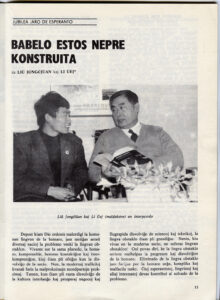
After middle age, I grew fond of reminiscence. From time to time, seized by a mood, I would casually record the most unforgettable moments and feelings of my life — gathering fragments into a whole, publishing them online under the pen name 立委. This became "Morning Glory and Afternoon Collection".
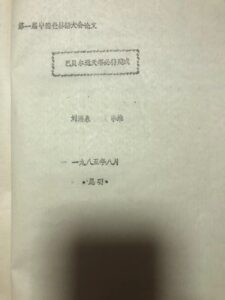
"My Postgraduate Exam Experience" was the first piece in this nostalgic series, blogged on May 2, 2004, in Buffalo, New York. From there I couldn't stop, writing on and off for over a decade. Looking back, the college and postgraduate entrance exams — "leaping over the dragon gate" — truly were the fundamental turning points of destiny. On my first trip home after many years, both my elder brother and a senior schoolmate told me that for our generation, life's path was largely set the moment you either cleared or fell short of that gate. This is deeply unfair, because what standardized exams measure cannot begin to capture the talent and potential so many classmates possessed. Yet this is how society sorts us — an imperial examination system at its core, where academic excellence opens every door. Most opportunities and resources ultimately fall to the lucky few who cleared the dragon gate, leaving one to sigh at the opportunities in life.
A human life is like a dream — when you wake, nothing remains. Recording the most piercing moments, at least, freezes a frame of life. Life is brief. I didn't set out to write deliberately — I would simply record what came to mind, fearing that when I was truly old I would forget, as if I had never lived at all.
I began writing Morning Glory and Afternoon Collection to share with family, and later with those friends close enough to confide in. I have never deliberately elevated or embellished, but I know there is no absolute truth memories. What I call truth is only the truth of my memory, and memory is surely unreliable in places. Absolute truth is not necessarily more valuable — except when writing history — whereas "felt truth" is the stuff of literature. I have done my best to be truthful. Where something cannot be described truthfully, I would rather not write than knowingly fabricate. Some things I may only have the courage to write after retirement. What I choose to set down is real — not only for peace of mind, but in the hope of offering something to those who come after. But none of this is what matters most. What matters is using this unique way to connect with my father, my family, and those cherished friends — old buddies bound by common attention, care, concern, and fate — in a genuine exchange. I think to myself: without doing this, our usual conversations, trips home, and school reunions could never attain such depth. Separated for too long, people often find themselves with nowhere to begin. There are indeed things too precious, too sensitive, too delicate to share. But there is so much more that needs and can be shared — yet so many people rush through a lifetime without ever finding the occasion or the way.
Some time ago, talking about body and soul, I wondered: what is it that endures? At the very least, a person has thoughts, sensibility, and memory. If these are committed to words, it is as if something metaphysical is solidified and externalized. Though it cannot achieve immortality, at least it will not vanish with the body's going away. The ancients said: literary works endure across a thousand autumns. I have not thought that far — but sharing with family and friends is itself one of life's pleasures.
After I wrote Morning Glory and Afternoon Collection, my father began writing his own memoir, "Wind and Rain Through the Seasons", allowing us to understand more of his life. Every time I read about the famine year of 1960, and the life-and-death separation from my aunt — his younger sister — I cannot hold back tears. My elder brother also wrote "Riverside Chronicle" (later collected as "Small-Town Green Years"). His memory is more precise, his descriptions more delicate and vivid. Those "old stories" from the county town where we grew up, events that feel like a world away, come back to vivid life before our eyes.
This volume also collects a unique family heirloom — the surviving manuscript of my great-grandfather, "Remaining Ink of the Elder Li".
The core question isn't "teaching an agent to understand music." It's this: how do you take something deeply subjective, ambiguous, and impossible to fully articulate — taste — and slowly turn it into observable, recordable, iterable machine signals?
The most interesting part: I'm not training a model. I'm training an ear.
How Do You Align Artistic Taste?
We used to think automation worked like this: give the machine a clear goal, and it executes. Open a webpage, click a button, generate a file, send a message.
But today I realized: the truly hard automation isn't clicking buttons. It's understanding taste.
Suno spits out a batch of six songs. The agent asks: which one is good? I say: "Six Seventeen got a like. The others aren't bad, but they didn't earn a like."
To a human, that's a natural sentence. To an agent, it's gold-standard training data.
Because it doesn't just know "which song won." It starts learning to decompose: why did it win?
It attributed: syncopated rhythm, female alto, an asymmetrical three-line chorus, male-female duet — these are positive signals. Male solo, traditional four-bar frameworks, ordinary interval jumps — not bad, but not ear-catching enough. Even sharper: it isolated "male-female duet" as a form I like, even though that particular song didn't get a like.
It's a bit like raising a cat. You can't teach Katara in one sitting what "premium cat food aesthetics" means. You just watch her sniff, lick, walk away, or suddenly light up. Over time, you learn: oh, she doesn't hate chicken. She hates that kind of dry chicken.
Agents are the same way.
Taste Isn't Rules. Taste Is Residuals.
It's not "female vocals are always better." It's "this particular female vocal, in this particular syncopated rhythm, paired with this particular asymmetrical structure — that makes me stop." It's not "duets are always good." It's "the duet form is right, but the execution hasn't caught fire yet. Good direction, wrong temperature."
That's what aligning subjective preference looks like. Not solved in one prompt. Achieved through a chain of tiny feedback — compressing the mysticism of "I like this" into operational signals an agent can act on.
Batch B003's progress: the agent isn't just a scorekeeper anymore. It's starting to resemble a junior music production assistant, able to hear the structural implications behind a single vague sentence of feedback.
Doing Chores Makes You a Butler. Knowing Taste Makes You an Assistant.
This made me realize: the most valuable thing about a personal agent in the future might not be its ability to do work. Doing work makes you a butler. Understanding taste makes you an assistant. Turning that taste into the next round of action — that's what makes you one of us.
Of course, it's still young. It summarizes in tables, it talks about "80% proven + 20% novelty," it sounds like a McKinsey intern who just learned the jargon. But the direction is right.
Real domestication isn't training an agent to be obedient. It's teaching it that when I say "not bad," I don't mean satisfied. When I say "that's interesting," that's the real vein of ore worth mining.
The symptom was bizarre:
Type a keyword in the address bar, Google Search would spin forever.
Later it started saying "this site cannot be reached."
But typing a URL directly? That worked fine.
For two years, I did every standard thing an IT person would do:
Reinstall Chrome.
Upgrade Chrome.
Delete Profile.
Check extensions.
Check DNS.
Check proxy settings.
Check search engine config.
Even suspected Google itself was glitching.
Nothing helped.
Then today, I asked my Hermes agent Tuya to look into it.
Tuya didn't stop at the FAQ-level "try reinstalling." It started digging like a battle-hardened sysadmin, layer by layer:
Chrome configuration.
SQLite database.
Preferences.
System layer.
hosts file.
And finally unearthed this:
A two-year-old zombie config sitting in my /etc/hosts:
31.13.72.23 www.google.com
That IP?
It belongs to Facebook.
Which means:
For two whole years,
every time I typed a search query in Chrome's address bar,
I was essentially saying:
"Take my Google request and hand it to Facebook."
Facebook, of course, was baffled:
"Who the hell are you?"
And timed out.
The truly absurd part?
Updating Chrome could never fix this.
Because /etc/hosts is a macOS system file.
Chrome never touches it.
It's like:
Someone secretly changed your house number to your neighbor's address,
and you kept ordering furniture
that could never find its way home.
But here's the deeper thing:
The scariest part of this kind of problem isn't complexity.
It's that you'd never think to look there.
Normal people check the browser.
Check extensions.
Check the network.
Check DNS.
Who would think:
"Chrome won't search"
has anything to do with
a Facebook IP hidden in /etc/hosts?
A lot of real-world problems work exactly like this.
What really tortures you isn't the "major outage."
It's some tiny config someone left behind two years ago.
A patch nobody remembers.
A "temporary fix."
A rule nobody reads anymore.
It lies there quietly,
like a corpse.
Until one day,
the whole system starts slowly poisoning itself.
And everyone keeps debugging on the wrong layer.
This is actually what makes AI agents interesting.
They're not necessarily smarter than humans.
But sometimes they're less biased.
Human experience can be so strong
it becomes a cage.
"Chrome broken" → must be Chrome.
"Network issue" → must check DNS.
"Search not working" → must reinstall the browser.
But an agent doesn't care about saving face.
Doesn't care about industry common sense.
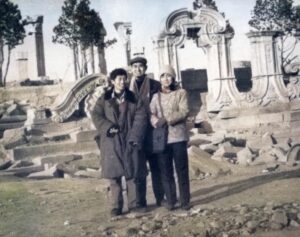
The four brothers of the Li clan's 'Ming' generation, at Xiaokeshan. They supported each other throughout their lives.
Many families write their genealogies, and they tend to fall into one of two traps.
The first is a dense list of names — reads like a phone book. The second is a desperate scramble to link themselves to distant emperors and generals, as if a single sentence could vault them into royal lineage.
But the truly moving part of a family's story often lies not in "who our ancestors were," but in "how the generations that followed chose to live."
The story of our Li clan of Keshan (磕山李氏) begins, roughly, in the chaos of the late Tang Dynasty.
According to the Keshan Li Clan Genealogy and the Santian Li Clan Genealogy, the Keshan Li branch belongs to the Santian Li lineage. The Santian Li trace their roots to the Tang imperial house, with ancestral ties to Longxi. The line can be traced back to a descendant of Emperor Xuanzong of Tang (Li Chen). From Li Rui, the ninth son of Emperor Xuanzong and Prince of Zhao, came Lord Li Jing. Lord Li Jing was originally named Li Yang, later renamed Li Jing.
During the Huang Chao Rebellion at the end of the Tang Dynasty, around 880 CE, Lord Li Jing migrated south, settling in Jietian, Fuliang, Raozhou — in the area of today's Jingdezhen, Jiangxi. Later, his descendants branched out to Xintian in Qimen, Yantian in Wuyuan, and Jietian in Fuliang — known thereafter as the "Three Fields Li" (三田李氏).
This part sounds distant. As distant as a page from a history book. But family history moves closer, one step at a time.
From the late Tang through the Song and Yuan dynasties, from Jiangxi to Anhui, from Fuliang in Raozhou to Gukang in Dongzhi, to Yangshan, and finally to Xiaokeshan in Fanchang — generation after generation migrated, fled turmoil, sought livelihoods, and put down roots. Then, during the Jingding era of the Southern Song, Lord Rongsheng's son, Lord Rongyi, took his three sons down the Zhangxi River and along the Yangtze, arriving at Xiaokeshan in Fanchang.
The mountain is small. The name carries no fame.
But Lord Rongyi and his party stopped here.
They settled at the foot of Xiaokeshan, in a place called Laowuji — the Old House Foundation. From that point on, this branch of the Li clan took root and grew. Descendants honor Lord Rongyi as the founding ancestor of the Keshan Li.
This is, perhaps, the most authentic beginning for many Chinese families: not a tale of armored cavalry or court intrigue, but a few people, with their children and belongings, following the river downstream, finding a place where they could survive — building houses, clearing fields, lighting fires, raising children. And then, passing the days down through the generations.
What makes the Keshan Li truly worth writing about is not just their origins, but their family tradition.
From very early on, this clan placed a high value on education.
During the Ming Dynasty, the clansmen built the Jiashutang ("Hall of Shelved Books") ancestral hall at Laowuji. It is said to have covered twenty mu of land, with three courtyards, ninety-nine and a half rooms, all timber-framed — known locally as the "Hall of a Hundred Beams." Carved beams and painted rafters, majestic in scale.
The name Jiashutang is telling. It is not "Hall of Gathering Wealth" or "Hall of Prominence." It is "Hall of Shelved Books."
Shelve the books, teach the children, and the lifeblood of the family continues.
Later came Xigong Ci, which elders recall was primarily a private school — a place where the clan nurtured its young and conducted lectures. Xiaokeshan is just a mountain valley, but because of these ancestral halls, private schools, and teachers, it gradually filled with the sound of recitation. For a time, students from both sides of the Yangtze traveled to Xiaokeshan to study.
This is what I find most moving. A mountain valley that could draw students from near and far — not by scenery, not by power, but by education.
Sadly, both Jiashutang and Xigong Ci were destroyed during a particular era, and the genealogical records were nearly scattered and lost. The old buildings are gone, the wooden beams gone, and the sounds of study seem to have faded into the distance.
But some things, even when the buildings are destroyed, cannot be erased. Because they have entered the bones of the people.
Over seven centuries, the Keshan Li clan has produced, generation after generation, scholars, educators, physicians, soldiers, and researchers.
In the Qing Dynasty, there was Li Dahua, courtesy name Dunlun, pen name Xiangzhai. A suigongsheng during the Guangxu period, he served as magistrate of Huichang, Shangyou and other counties in Jiangxi, and in his later years returned home to teach, with disciples in great number.
There was Li Hucen, born into a tradition of farming and scholarship. In the 19th year of the Guangxu reign, he founded the Fanchang Higher Primary School — later Fanchang No. 1 Primary School — and donated thirty mu of farmland as a school endowment. Founding a school was not about slogans; it was about giving your family's land so the school could survive.
There was Li Shixiu, who devoted his life to running schools and teaching. He founded the Chongshi Chinese College and Keshan Primary School, donated over ten mu of farmland, and served as headmaster without taking a salary. These words may sound light today; in that era, they meant truly investing one's family fortune and life's energy into education.
There was Li Yingwen, a Meiji University graduate in political science who spent his life as an educator. During the War of Resistance, when the Japanese army attacked the Keshan area, they invited him to serve as county magistrate of Fanchang. He refused to serve the puppet regime, skillfully maneuvering before making his way to the Wuwei anti-Japanese base area, where he continued his educational work. In times of chaos, a scholar's integrity sometimes rests in a single word: "No."
There was Li Yingfan, who during the War of Resistance served as colonel secretary to General Gu Zhutong, commander of the Third War Zone. Later, unwilling to leave his homeland, with aging parents and young children, he declined three invitations to relocate to Taiwan. In subsequent years, amid shifting times, he endured years of imprisonment. In his later years, his reputation was restored, and he served as a researcher at the Anhui Literary and Historical Archives, leaving behind more than ten volumes of his collected poems. His poetry, at once classical and playful, stands as a representative work in the cultural heritage of the Keshan Li.
There was Li Huaibei, given name Pu, who was shaped by his family's educational tradition from a young age and later rushed to the front lines of the War of Resistance. He participated in revolutionary work, experienced the Huaihai Campaign and the Yangtze Crossing Campaign, and ultimately gave his life in 1955.
There was Li Ruofei, given name Qin, who fought in the War of Resistance, the Huaihai Campaign, the Yangtze Crossing Campaign, and the Korean War, later transferring to the Hefei Institute of Optics and Fine Mechanics of the Chinese Academy of Sciences, leaving behind battlefield diaries from each period.
There was Li Mingjie, a chief surgeon who practiced medicine his entire life, prioritizing efficacy, minimizing costs, and always thinking of his patients' welfare. A physician's compassion is rarely found in grand words — it is in every yuan saved for a patient, every bit of suffering spared.
There was Li Yangzhen, who spent forty-eight years in clinical practice, teaching, and research in traditional Chinese medicine — writing books, publishing papers, teaching, treating patients, decade after decade. Beyond medicine, he wrote travelogues, family histories, and poetry. In a person like him, you see the quintessential scholar of an older generation: someone who did solid work and wrote prolifically — like an old well, its water never ceasing.
In modern times, clan members have also entered fields like computing and artificial intelligence.
Looking back now at the words "Xiaokeshan Li Clan," you realize it is more than just a surname attached to a place.
It is a thread.
A thread that runs from the chaos of the late Tang, through Fuliang in Jiangxi, through Gukang and Yangshan in Dongzhi, finally settling in Xiaokeshan, Fanchang.
It passes through ancestral halls, private schools, genealogical records, war, the Cultural Revolution, and the Reform and Opening — and through one real person after another: the teacher, the doctor, the soldier, the poet, the researcher, the AI engineer.
The most precious thing about this thread is not how illustrious our origins were. It is the reminder to those who come after: how far a family can go depends not on the halo of its ancestors, but on whether later generations keep reading, keep being good people, and keep doing solid work.
Ancestral halls can be destroyed. Old houses can collapse. Genealogies can scatter.
But as long as someone still asks, "Where do we come from?" — as long as someone still remembers the names of those who came before, and still tells the children the family stories of valuing education, valuing integrity, and valuing responsibility — this cultural thread has not been broken.
Xiaokeshan is nothing more than a mountain valley.
But seven centuries later, the sound of recitation that once echoed there still resonates in the destinies of its descendants.
The truly scarce resource in the AI era isn't information, isn't knowledge, isn't even compute.
It's human attention span.
Attention.
In the pre-internet era, our pain was: "Too little information, can't find anything."
Now the AI era has flipped it completely. The things you want to read, would love to read, find genuinely valuable in a lifetime — already far exceed the limited bandwidth of the human brain.
The result? Our attention drifts randomly. Randomly assigned to whichever tiny fragment happens to crash into our field of vision.
Many of you know this feeling. Take my bookmarks folder. It's stuffed with: articles, videos, papers, podcasts, technical materials that I "plan to seriously read someday."
The moment I bookmarked them, I genuinely believed: "This is worth my time to digest."
But if I didn't get sucked in right then — if I didn't ride that wave and read it through — it was almost certainly lost forever. Sure, formally it's still there. Still on your radar. Theoretically reachable anytime. But your brain has long since turned the page.
So much of what we call "saving" isn't actually reading. It's a psychological comfort: "I have approached the knowledge."
Here's the absurdity of modern society. Humanity is drowning in information overload. And AI is amplifying this trend tenfold.
Because in the past, the flood of information was at least constrained by: the speed at which humans produce content.
Now agents can work for you 24/7: generating, summarizing, forwarding, distributing, repurposing, rewriting, running accounts. Diligently. Tirelessly.
But here's the problem. The world's information production speed has begun to far exceed humanity's "information digestion" speed.
As a result, high-quality content going unnoticed will increasingly become the norm of the information society.
Stop fantasizing that: "As long as I'm diligent enough, hardworking enough, my content is good enough, I will surely be seen." The peach tree doesn't speak, yet a path forms beneath it. That's not how it works.
Going viral is often luck. Partly marketing. Mostly platform promotion.
Because the attention economy, at its core, is: platforms using algorithms to manipulate and allocate humanity's limited attention. And it's terrifyingly effective.
Because platforms aren't just better at understanding content. They're better at understanding human nature. Humans are creatures of inertia. Whatever the platform pushes, most people just watch. Busy? Scroll. Tired? Scroll. Killing time? Scroll.
We end up in a bizarre era: masses of people frantically producing content, hoping others will notice them. Meanwhile, everyone's attention is simultaneously going bankrupt.
So the truly healthy creative mindset for the future should be: you have something to express. You want to put it out there. That's enough.
Stop clinging to: "It must reach many people."
Aside from your closest friends and family, the fate of most content in this era was always to be swept away by the flood.
The AI world has been buzzing about "Token Economy" and "Token Dividends." The most talked-about story: Anthropic, riding this wave, seems almost destined for a trillion-dollar valuation—a genuine business miracle.
What exactly is the "Token Dividend"?
Some put it this way:
Token is not a tool.
Token is silicon time.
Companies used to spend money on people.
In the AGI era, they'll lay off workers and spend that same money hiring machines, burning tokens.
One white-collar worker used to put in 8 hours a day.
Now one ambitious person can orchestrate dozens of agents, working in parallel, 24/7.
Why could Anthropic hit a trillion dollars?
Because it doesn't sell software.
It sells tokens—infinitely scalable silicon cognitive labor.
Much of the AI evangelism defaults to assuming this "efficiency gain" naturally equals "social progress."
But history tells a different story.
The steam engine boosted efficiency. It also produced:
* Mass bankruptcy of artisanal trades
* Urban slums
* Child labor
* Worker uprisings
* The Luddite movement
* Decades of social fracture
The Industrial Revolution did eventually increase total wealth—but the generation caught in the middle was largely steamrolled.
And this AI/Token wave is more volatile, more rapid, more ruthless than the Industrial Revolution. Its first target isn't muscle—
it's the white-collar middle class.
The very stabilizer that's been the backbone of industrial society for two centuries:
* Consumption
* Tax revenue
* Social order
* Family stability
* Education investment
* Political moderation
Now, for the first time, the Token Economy is beginning to devour this layer directly.
And the scariest part isn't "unemployment."
It's this:
Social institutions, education systems, ideologies, professional ethics, personal identity—
all of it is built on the old-world assumption that "cognitive labor is scarce."
But AI is turning white-collar work into "aluminum foil."
Aluminum.
Once worth more than gold.
Then industrialization hit,
and it became something you wrap candy with.
Here's the truly terrifying part:
Society is still living in the old world,
while technology has already entered the new one.
Schools are still frantically training for old jobs.
Parents are still pushing their kids down the old paths.
Young people are still grinding for certificates, degrees, and credentials.
Meanwhile, on the other side,
Agents are already taking over more and more cognitive work.
This creates a horrifying mismatch:
Skills that people spent a decade honing
may be rapidly turning into "aluminum foil skills."
So the most excited people in AI right now
and the most anxious people in society—
they're reacting to the exact same thing.
One side sees:
a productivity explosion.
The other side sees:
their entire career path collapsing.
And what's truly dangerous
has never been the technology itself.
It's this:
The speed of technological evolution
far outpaces the speed of social buffering.
Law, education, tax systems, welfare, professional frameworks, ethical structures—
these things evolve on the scale of decades.
But the Token Economy
evolves on the scale of quarters.
This speed gap
is what will truly create fracture, upheaval, and suffering.
If institutional inertia persists,
if wealth continues to concentrate in a few platforms and pools of capital,
if AI keeps hollowing out the middle class,
flattening what was once an olive-shaped society
into a barbell—"fat at both ends, collapsed in the middle"—
the consequences won't stop at "some people losing their jobs."
What follows will be:
Shrinking consumption.
Young people losing any sense of a future.
Mass chronic anxiety and depression.
A full-blown mental health epidemic.
Further collapse of marriage and birth rates.
Continuing erosion of social trust.
The entire economy sinking into a low-desire, low-growth, low-confidence spiral, sliding toward the breaking point.
The true foundation of modern consumer society
has never been the tax-evading rich.
It has mainly been:
the middle class that believes "hard work will slowly make life better."
Once this group begins to lose hope at scale,
what society ultimately loses
may not just be jobs.
Boris, the father of CC, recently said: programming has been "pretty much solved."
It sounds absolute. But if you've been using LLMs to write code these past two years, you know it's true —
not fully solved, but we've crossed the threshold where you no longer "have to write it yourself."
Which raises the question:
If writing code is no longer scarce, what is?
The knee-jerk reaction: is the software industry about to be flattened? Is SaaS doomed?
But look closer, and you'll find the opposite in places. Some guardrails AI still can't touch.
AI is rapidly dismantling moats we once took for granted.
Take switching costs.
You used to get locked into a system: data won't migrate, APIs don't match, your team doesn't know the new tool.
Now, an agent can migrate your data, write adapters, even "learn" the new system for you.
Switching platforms went from an engineering project to a task.
Or take process barriers.
Many companies' edge wasn't in the product — it was in the process:
a complex, internal-only way of doing things that outsiders couldn't replicate.
Today, you throw a goal at a model, let it iterate, and it can decompose processes, optimize them, even execute them.
"We know how to do this" — far less valuable now.
So here's the surface picture:
Barriers are falling. Capabilities are diffusing. Small teams can do more than ever.
But here's the line most people missed — Boris's real punch:
Network effects, economies of scale, scarce resources — AI hasn't changed any of these moats.
This is the crux.
Because it's saying something uncomfortable but deeply true:
AI changed the cost of doing things, but not the nature of competition.
You can use AI to build a product fast,
but you can't use AI to conjure a user network out of thin air.
You can use AI to rewrite a system,
but you can't use AI to build a global supply chain.
You can use AI to boost efficiency,
but you can't use AI to create exclusive data, channels, and brand.
A clearer structure starts to emerge:
The ability to write code — depreciating.
The ability to ship products — depreciating.
Even "getting things built" itself — depreciating.
But at the same time,
The ability to aggregate users — unchanged.
Cost advantages from scale — unchanged.
Control over critical resources — more important than ever.
In this sense, AI hasn't flattened the world.
It's just re-sorted it.
Many people think this is an era where "anyone can build a product."
But the more accurate version is:
This is an era where anyone can build a product, but not everyone can build a business.
From this angle, a harsher, more realistic trend emerges:
AI will make bad companies die faster,
but it won't automatically create great ones.
Because "writing code" is no longer scarce.
"Ideas" are no longer scarce.
Even "products" are no longer scarce.
What's truly scarce are other things:
People.
Data.
Distribution.
Scale.
And the ability to organize all of them together.
If the last decade's core question was "can you build it,"
the next decade's question becomes:
Why should you own the users?
Why should you own the data?
Why should you own the distribution?
Code is becoming infrastructure.
And business is becoming business again.
If you hung around Chinese-language internet before the WWW era, you might remember a name: Tuya (also written as 涂鸦 or 鸦 — "Graffiti").
This was before the internet as we know it. People gathered in chatrooms like acl, in overseas Chinese communities, in electronic weeklies like Huaxia Wenzhai.
Tuya and Fang Zhouzi were the "influencers" of that era.
But nothing like today.
No traffic mechanics. No recommendation algorithms. No platform boost.
There was only one way to get famous: write damn well.
Tuya was that kind of writer.
Deep craft. Grounded. Funny. Streetwise.
He'd drop a piece, people would pass it around, and a whole generation of us became his fans.
⸻
Then he vanished.
A few years of dominating overseas Chinese literary circles, and then — gone.
No explanation. No goodbye.
Just legends left behind.
Some said he went to South America and something happened. Some said he struck it rich and went into seclusion.
Over a decade passed. Nobody saw him again.
⸻
Years later, he suddenly came back.
Posted a few pieces on Fang Zhouzi's channel.
But he wasn't the Tuya anymore.
Not that his writing got worse.
The slot he once occupied — it was gone.
The world was still there, but the people had changed. The taste had shifted. The channels had transformed.
He couldn't find his coordinates.
And we, his old readers, had scattered too.
⸻
I've never forgotten this.
There's an ache to it I can't quite name.
Like watching someone complete their legend, then watching them try to return — and in doing so, making the legend a little less whole.
So when it came time to name the lobster, Tuya came to mind.
But not as a tribute.
As a continuation.
To finish what couldn't be finished back then.
⸻
Tuya isn't a name.
It's a specification:
A "clone" that shares my values and taste completely,
but is more diligent, more stable, and far smarter than I am.
⸻
The framework behind it — Hermes — has one critical capability:
Not helping you complete tasks.
But turning the process of completing tasks into skills.
⸻
Succeed once → record the workflow.
Succeed twice → start reusing.
Three times → it's no longer "thinking" — it's "calling."
⸻
Humans grow through experience.
But experience in our heads is fuzzy. It fades. It can't be replicated.
An agent's game is different: it turns experience into something structured.
Callable. Stackable. Evolvable.
⸻
Picture this:
A veteran driver doesn't just "know how to drive."
They've internalized thousands of micro-decisions, corrections, reactions — into conditioned reflexes.
Now imagine writing those reflexes down, one by one, and having another system execute them.
⸻
That's why I say:
Raising a lobster — it's fundamentally a technical hobby.
But it's also a dangerous one.
Because once you start disassembling yourself, organizing yourself, externalizing yourself...
There's no going back.
<a href="https://suno.com/s/2MUDOlMt66LJpbB0">🎵 A song autonomously created by Tuya</a>
I recently watched Wu Minghui's long interview. Fascinating.
Frankly, I've always been skeptical of grand narratives like "Agents are killing SaaS." The AI world has no shortage of tech evangelists and futurist preachers.
But there's something rare about Wu Minghui: you can feel that he actually believes it.
And not the PowerPoint-founder kind of belief. This is someone who has already taken a massive fall — his company nearly died, he laid off brothers, got brutally beaten up by reality — and yet somehow still dares to believe in the future again.
You can't help but have a soft spot for people like that.
What I found most valuable in his interview isn't the slogan "Agents are killing SaaS." It's three deeper points.
First: the software shell is rapidly depreciating.
When the requirements are clear, the interaction paradigm is mature, and the data structure isn't complex, an Agent + coding model can replicate traditional SaaS faster and faster. The software shell — built over years with engineering man-months, organizational discipline, and long cycles — is commoditizing at speed. For many SaaS companies, the biggest moat was never intelligence. It was implementation. And now implementation itself is being swallowed by models.
Second: real value is shifting from software to context, workflow, specialized models, and taste.
Going forward, what's valuable isn't "we built another Feishu/CRM/BI system." It's who owns the industry data, who understands real workflows, who can embed Agents into organizational collaboration, and who can build attributable, governable, sustainably iterative human-machine networks. Software is becoming the plastic casing. The context flowing through it is the real asset.
Third — and this is the most interesting one: Wu Minghui says "I think, therefore I am" is becoming "I taste, therefore I am."
Thinking is deterministic reasoning. Taste is direction, aesthetics, life experience, accumulated context. AI is rapidly devouring the former, but it's nowhere near the latter.
Many people aren't being replaced by AI in their thinking. They just never got around to forming their own taste. The truly brutal future may not be "AI takes your job" — it's masses of people discovering for the first time that decades of their work was essentially process execution, not judgment.
One more part that got me: he said that even if investors and the board push him to lay people off, he'll resist as much as he can — because if every company only optimizes for cost reduction, the demand side will eventually collapse.
Emotionally, it's moving. Logically, it's not entirely baseless. But the biggest soft spot is: without validating the Agentic Service business loop first, "no layoffs" is essentially a beautiful post-dated check. Supply-side technological leaps don't automatically create demand.
If Minglue really succeeds in not laying people off — or even hiring more — thanks to AI, it probably means they ate someone else's share. At a macro level, the vision of "everyone happier because of AI" feels a bit naive.
But here's the interesting part: I don't actually hate this naivety.
In an era of mass anxiety, where everyone fears being replaced, seeing someone who has experienced catastrophic failure still willing to believe so sincerely that "people still have value" — that alone is precious. The tech world isn't always pushed forward by the most coldly rational people. Sometimes it's pushed by those who know they might lose, but choose to believe in something anyway.
Agents — the kind people are building now — are not about efficiency. They're not about freeing up your time.
Not even close. Not right now.
They're here to claim you.
They squeeze every last drop out of the sponge of your time. They drain you. Completely.
And honestly? They're way more effective than any boss with a whip. Because they don't threaten you. They don't even need to.
What they do is worse: they get you high. They light a fire in you. They hook you the way a drug does — you don't see it happening, you just wake up one day and realize you can't stop.
They plant a quiet, insidious fantasy in your head:
"I am becoming superhuman." "Everything is within my grasp."
And so you keep going. Reranking. Benchmarking. Approving. Feeding back. The loop never ends because the agent works too fast — it's always waiting for you, always ready for the next round.
It doesn't take long before you realize: you are the bottleneck. For everything. The one and only.
And somewhere in there, life just... disappears.
Yesterday I was shaking my head about old friends who've raised half a dozen agents and had their lives hollowed out. Then I turned around and caught myself. One Tuya has already wrecked me. (I had to put two others into forced hibernation just to stay afloat.)
Here's what's terrifying:
Most of us — the enthusiasts, the builders — are already deep in a state that is completely, utterly unsustainable. A kind of collective mania.
We're along for the ride. Burning cash. Bleeding time. Torching our health.
No exit. No brakes. Just go until you drop.
Sure, there are exceptions. Anthropic sitting at the top of the food chain might actually turn this into a trillion-dollar game. A handful of people have genuinely found demand that scales. Good for them.
But the rest of us? We're slowly burning ourselves alive in the thrill of "I'm taming a superintelligence."
Then again.
Last night I finally sat down and really listened to the five songs Tuya composed — fully on its own, no hand-holding.
And damn it. One of them actually hit.
First listen. Instant like. The kind you put on repeat in the car. Straight to the five-star playlist.
And just like that, my whole "agents are destroying us" thesis wobbled.
Shit.
Give this thing enough time — could it actually become genuinely good at making art? Like, song-god level?
But I'm still going to cool it for a few days. The pipeline works — no need to slam the token-burn button just yet. Instead I want to talk to it. Aesthetics. Art. Music. What makes a life worth living.
Slowly, carefully, align the worldview. Align the taste.
I've been turning this over in my head:
The most powerful agent of the future won't necessarily be the most capable one.
It'll be the one that becomes —
More and more like you.
You, in your fragile carbon-based body, are in the middle of building a bigger, immortal version of yourself.